Thursday, 19 March 2015

Acid Rain, Nikola Kostic

Nikola Kostic
Science, 9A
Mr. Youell
20.03.2015


Acid Rain, Causes, Effects, Remedies


Acid Rain could be described as any rainfall with the existence of high levels of nitric and sulfuric acid. It occurs in the form of rain, snow, fog, and molecules that settle on Earth’s surface. When the compounds, like sulfur dioxide, and nitrogen oxides are released in the air, they form a chemical reaction that forms the acid rain.  

Sulfur dioxide and nitrogen oxides can raise high in the atmosphere to react with water, oxygen, and other chemicals to create acidic pollutants known as acid rain. Sulfur dioxide and nitrogen oxides are easily able to react with the water, and can be easily carried by the wind. According to epa.gov, the main causes of the acid rain are the human activities. Over the past decades, with the industrial revolution, humans have released sulfur dioxide, and nitrogen oxides in the air, that they have changed the mix of the gases in the atmosphere. Power plants burn fossil fuels, and release large amounts of sulfur dioxide and nitrogen oxides, and in addition, cars, trucks, and other vehicles, from their exhausts, release sulfur dioxide, and nitrogen oxides in the air, which react with the water in the clouds to create the acid rain. As seen in figure 1, sulfur dioxide (SO2) and nitrogen oxide (NOx) are released in the air from vehicles and factories. When released into the atmosphere, they react with the water found in clouds. The solution of the reaction is acid, sulfuric acid (H2SO4), and nitric acid (HNO3). In nature, rain is naturally acidic, with a pH level around 5.0, but human activities have made it more acidic. Normal rain with the pH of around 5.0 would react with the alkali chemicals in the air, soil, bedrocks, and lakes. The reaction neutralizes the acid, but with sulfur dioxide and nitrogen oxides, the rainfall is too acidic, and the alkalis can't neutralize rain that is too acidic. Over time, acidic rain damages trees, crops, lakes, rivers, and seas


(Figure 1, sulfur dioxide, and nitrogen oxide react with water in 
the clouds to create nitric, and sulfuric acid.)


Acid rain affects lakes and streams in two ways, chronic and episodic. Chronic acidification results in many years of acidic rainfall. It reduces the alkalinity in the lakes and the streams, and increases the acidity of the water. Also, chronic acidification reduces nutrients and calcium for the fish to survive, which results in death of the fish. On the other hand, episodic acidification is a sudden rise in the acidity of the water because of the sudden rainstorm. Episodic acidification causes sudden change in chemistry of the water, which can lead to high concentrations of substances, like aluminum, which is toxic for the fish.
As epa.gov states, acid deposition may influence forest vegetation and soils. Acid rain weakens trees' immune system, making them more exposed to diseases. As seen in figure 2, acid rain has dissolved the leaves of the trees, and has made the trees more exposed to the diseases. Throughout the Eastern United States, the spruce has been in the decline because acid rain may remove soil nutrients as calcium and magnesium which are necessary for the trees to grow. Acid rain deposits nitrogen cause eutrophication, over nourishment, which can lead to unwanted growth of algae in areas where rivers meet oceans. 
Acid rain has been shown to affect human health, but some particles formed from sulfate and nitrate ions could affect people with lung disorders, like asthma and bronchitis. Buildings made out of calcium carbonate can be affected by the acid rain. The acid rain can turn calcium carbonate to calcium sulfate, which can be washed away. 


(Figure 2, tree leaves had been dissolve by the acid rain, 
and the trees are now destroyed by the diseases.)

Aware of the effect on the human health and the environment, humans have taken number of steps to reduce sulfur and nitrogen emissions in the air. According to geography.about.com, Governments are requiring energy producers to use scrubbers to clean smoke stacks, which are going to trap the pollutants before they are released in the atmosphere. Modern cars try to use converters that reduce their emissions. In addition, new energy sources have been found, like energy captured from the sun using solar panels. In schools, kids are being taught to conserve energy, by turning off electronics when not using them, by encouraging parents to use less pollutant source of energy, and trying not to use air conditioning often. I think that this is a big problem, and slowly the acidity of the streams will get high enough so that fish wouldn't be able to survive, unless they adapt to their environment. People have to react fast, and reduce the toxic airs, and try to reduce the acidity of the streams 


Acid Rain


Kiril Todorov
Mr. Youell
19.3.15
Science 9B

Acid Rain

            Acid rain is currently not a major problem however it can escalate into something bigger if it is not stopped. In order for actions to be taken first we need to understand the cause of acid rain, the damage it does to nature and how we can prevent this from happening. 

            Acid rain is a result of a chemical reaction between water and different chemicals such as; sulfur dioxide (SO2) and nitrogen oxides (NOx) . The chemicals can very easily rise into the air, into the atmosphere where they mix with the water vapor in the clouds and from there this acidic mixture can then come down as acid rain, snow, or even fog (fig 1).


 (Fig1 Cycle of how chemicals are mixed with water to create acid rain.)

 Another reason why this is such a problem is because the chemicals can really easily travel a long distance with the wind and have effects a regions which are not near the location that is producing the pollution. Acid rain is caused due to different human activities, the chemicals released in the air from things such as; power plants, cars, the burning of fossil fuels in order to produce electricity. Infact this pollution is so bad that it has altered the chemicals that make up or atmosphere. Naturally there is a certain amount of alkaline chemicals and acids in nature and they do get caught up in the water cycle, however they are no where as much as the amounts that are produced currently. So therefor acid rain has been a natural occurrence and the nature can cope with it to some extent however the acidity of the rain would be no where near as high as it is currently and that is the cause of the problem.

            Acid rain is not only harmful to humans, but also to the nature and marine life. Acid rain does not have direct effect on humans as even though it is acidic it is not strong enough to cause any direct physical damage to a human being, however the problem is the cause of acid rain which is air pollution that is harmful for humans. The chemical particles are dangerous for the respiratory system as they can cause asthma, bronchitis and other respiratory problems, but unlike humans the forest is affected much greater way from the acid rain. First of all when the water is absorbed by the soil it dissolves nutrition like magnesium and calcium which trees need in order to stay healthy, meanwhile it also releases aluminum into the soil which causes the trees to have problems absorbing water. The other problem is that actually the trees that are the furthest away from the factories and are located on mountains are under the biggest peril, as the acids rain is carried off through clouds and when it condenses in the mountain creating an acidic fog and raining it damages the nutrients in the leaves/needles causing the trees to be more prominent to infections (fig 2).


(Fig 2 On the left is the branch damaged from acid rain while on the right is a healthy branch)


 It also has effect to marine life as the Ph levels of water become more acidic at such a fast rate the aquatic life can not cope and adapt and therefore may die out if the pollution continues, this becomes a bigger problem during spring due to the larger amount of water and all the rain and snow gathering into lakes. This occurrence is known as episodic acidification. At the increasing rate of air pollution nature is slowly getting damage more and more and soon more noticeable changes might occur if the pollution is not stopped, or decreased.

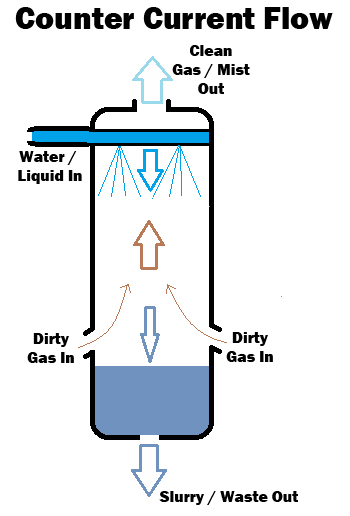
            As with every other major problem there are already solutions in place to help with the air pollution so it can prevent acid rain. In 1990 a Clean Air Act Amendment was issued which limited the release of sulfur dioxide and nitrogen oxide from power plants. Also scientists have come up with different ways to also clean the toxic smoke that is being emitted when the fossil fuels are burnt, some of the methods vary from using coal containing less sulfur, to using machines called scrubbers(fig 3).


 (Fig 3 a simple diagram of how a scrubber works.)


These machines where originally made to remove carbon dioxide from a submarine and it was refereed to as “pollution control devices that use liquid to wash unwanted pollutants from a gas stream” and that is exactly their purpose in the power plants however instead of just removing carbon dioxide they also remove sulfur dioxide from being emitted into the air.

            In order to prevent acid rain we need to understand the cause of it and stop it at the source because once the chemicals react with water there is nothing that we can do to stop the damage that acid rain creates. Big industries have taken it upon themselves to reduce the amount of air pollution created by their business now it is turn for the everyday people to take action and limit their use of fossil fuels to prevent pollution.


Bibliography:
"Acid Rain Facts, Acid Rain Information, Acid Rain Pictures, Acid Rain Effects - National Geographic." National Geographic. N.p., n.d. Web. 11 Feb. 2015.

"Acid Rain." EPA. Environmental Protection Agency, n.d. Web. 25 Feb. 2015.s)." 

"Clean Air Act (United States)." Wikipedia. Wikimedia Foundation, n.d. Web. 19 Mar. 2015.

"Scrubber." Wikipedia. Wikimedia Foundation, n.d. Web. 19 Mar. 2015.

"Acid Rain Effects." The Effects of Acid Rain on the Environment. N.p., n.d. Web. 18 Mar. 2015.


Tuesday, 17 March 2015

Acid Rain 💦💦💦


Kora Saint-Lot


Mr. Youell

Acid Rain

17th March 2015


Causes, Effects & Remedies of Acid Rain


According to US. E.P.A acid rain is a mixture of dry and wet deposited material that comes from the atmosphere containing a higher amount of nitric and sulfuric acids (nitrogen oxides and sulfur dioxide). The sources of the oxides that cause the acid rain are natural, volcanoes and decaying vegetation, and man made, combustion of fossil fuels (as seen in figure 1 and 2).


Figure 1: Factories producing lots of nitric and sulfuric acids.


Figure 2: Volcano spewing gasses into the atmosphere. 
When those previously mentioned oxides are found in the atmosphere they will react with the water in the clouds or the already falling rain and create weak acids known as acid rain. When that rain falls it causes lots of damage to many different things. Such as: buildings, forests, lakes, oceans, rivers and humans. The effect is not limited to only the areas where the most pollution occurs but carried by the wind the gasses can travel great distances and cause damage further away. In highly polluted areas the gasses can be incorporated into the dust and smoke and fall onto the ground. This is called dry deposit, which can be washed away by falling rain and this also increases the acidity.  
Figure 3: Diagram of dry and wet deposition.

When the acid rain falls onto any stone buildings or statues it corrodes it and bit by bit the rock fades. Famous limestone and marble monuments (building and statues from ancient Greece, Rome, Egypt...) are especially in trouble of being eroded. 


Figure 4: Effect of the acid rain on limestone statues.
Entire forests are being affected because the acid in the rain "weakens" the trees, making it easier for them to catch diseases. It also removes nutrients that the tree needs from the soil such as calcium and magnesium. Acid rain deposits nitrates that can lead to increases in nitrogen in forests. Nitrogen is an important plant nutrient, but some forest systems may not be able to use all they receive, leading to nitrogen saturation. In the Eastern United States, there is evidence of nitrogen saturation in some forests. Nitrates can remove additional calcium and magnesium from the soils. Continued nitrogen deposition may alter other aspects of the nutrient balance in sensitive forest ecosystems and alter the chemistry of nearby lakes and streams. The acid that falls directly into lakes and rivers causes the acidity of the water to fall and all living organisms inside the water are affected. Some types of plants and animals are capable of tolerating the change in pH. Some, however, are not able to survive and decrease biodiversity.
Figure 6: Deforestation because of acid rain.
Acid rain is a major problem and solutions are already being found and put into action to help with the pollution in the air that is one of the main causes of it. For example: Scientist have come up with various ways of cleaning the toxic gasses that are being released when fossil fuels are burnt. One of the methods is a machine called "scrubbers". The machines are basically devices that control the pollution by using liquids to wash toxic "pollutants" from the gasses released into the air (see figure  6 for more detailed diagram).
Figure 6: Diagram of the inside of a scrubber.
             Acid rain has become a big problem and people need to start reacting now before it is too late. Most of the damage is caused by human actions and can be reduced but each individual person needs to make a small step in conserving energy. Walking, riding a bike instead of taking a car when possible can be big contributors the the problem since energy production is the biggest cause of acid rain.  If we do not start taking actions now it will soon become irreversible and there will be consequences. Not only to the environment and earth but to us humans living on it. 


Acid Rain - Causes, Effects and Solutions

Acid Rain

Formation, Aftermath, Countermeasures


1. Acid Rain - What is it?

According to a German Webpage,..


The phenomenon of acid rain has been known since ancient times: for example, it was observed in ancient Rome where trees died near Galena metal processing factories.


But it was not until the late 1950s / early 1960s, that the spread of acid rain in Europe has been observed. 
Rain is determined acid or sour, when the pH-level of the water is under 5.6. Now when you look at a pH-scale you should think that it should already be acidic having a pH-level that is under 7.0 , but in fact it is proven that "normal" rain is already acid. That is because of the reaction between rainwater and carbon dioxide. The carbon dioxide (produced by our emissions) reacts with water to carbonic acid : CO2 + H2O H2CO3

2. The Chemical Aspect

Due to the facts above, CO2 emissions cannot be the cause of acid rain, so responsible for a pH-level less than 5.6 have to be other particles.
The pollutants, that cause the water to get acidic are nitric oxide/nitrogen monoxide ; nitrogen dioxide and sulphur dioxide . These Chemicals are also present in nature (soil,volcanoes,etc.) , but the majority is produced by us, humans, in everyday situations like traffic, households and especially by burning fossil fuels in power stations.

Nitrogen oxides :  2 NO2+ H2O          HNO2  + HNO3
2 HNO2  + O2           2 HNO3

Sulphur oxides : SO2  + H2O            H2SO3

Easy explanation of the process
All these processes take place in the troposphere, that means, from the lowest atmospheric layer up to an altitude of 10-12 km.

3. Effects
Acid rain affects soil, water, plants and buildings. When acid rain meets basic ground, eg Calcareous soil, the acid can be neutralized immediately. The, in the soil present, bicarbonate anions react with the protons of the acid.
In slightly acidic soils a so-called cation exchange takes place: Certain metal ions such as Calcium and magnesium ions replace the protons of the acid: they are captured by the sulfate ion, and washed out with this from the ground. The hydrogen ions remain in the soil and are neutralized by bicarbonate ions.
However, the buffering capacity of the soil can eventually be exhausted; then the acid is passed on to the groundwater, streams, rivers and lakes. If the water contains no basic ions that can neutralize the acid, this water becomes acidic. Results in the receipt of vegetation, changes in life forms, or even the complete extinction of these waters.
Acid rain can wash out poisonous minerals and heavy metal ions from rocks in the soil. For example, aluminum, cadmium or lead cations. This can also pass through the soil into water. But they can also be absorbed by plants as nutrients and thus poison the plants.
Acid rain, as just described, washes the nutrients out and the plants suffer in these areas of a nutrient deficient. In addition, acid rain also acts directly on the plants through the leaves. Overall consequences are that plants are susceptible to diseases, flower colours are bleached and it can even cause the death of the plants.
Also buildings are not spared from the harmful influence of acid rain
Acid rain is particularly aggressive to sand and limestone. This is associated with a crystal magnification, so the building starts crumbling.
CaCO3 + H2SO4               CO2  + H2O + CaSO4
An example of how expensive the restoration of such damaged buildings can be: For Westminster Abbey in London, about 10 million British pounds were spent until 1990 to eliminate the damage of acid rain.

5. Remedies
The first remedy to stop the effects of acid rain, was that the chimneys of factories / plants were built higher- with the result that the pollutants were equally disposed.
Then they began to install filter systems in factories / plants. In Germany, a decree to reduce emissions of sulfur dioxide and nitrogen oxides from power plants was adopted in 1983. With success. Pollutant emissions from large industry were severely restricted. In order to reduce the damage to plants and soil, the forests are limed in some places.
However, the traffic and a very large number of households emit pollutants. Although now they start to install catalysts in vehicles. Nevertheless, the use of fossil fuels in engines, household, power stations should be restricted. One measure would be here to expand public transportation networks and other  renewable energies to promote.


Tuesday, 3 February 2015

Ebola

The year 2014 was marked by a big Ebola outbreak in Africa. Unfortunately, events with negative consequences are usually the ones that get major attention of the world and are remembered for a long time. The Ebola outbreak took so many lives and instilled fear throughout the world. The reason I have chosen this story is because I want people to know more about this terrible disease and I want to pay homage to the victims.

The most severely affected countries were Sierra Leone (10561 cases, 3216 deaths), Guinea (2920 cases, 1913 deaths) and Liberia (8643 cases, 3700 deaths). (Fig. 1) The numbers shown represent suspected case and death counts reported by World Health Organization (WHO) by January 31, but they admit that the figures are underestimates, because of the difficulty in collecting the data.

                                                 Fig. 1  Map of infected countries

These countries have very weak health systems and few resources. In more developed countries it is easier to fight diseases and limit the outbreak, because there are more available resources. For this reason, it is very important that poor countries get all the help they need in order to avoid further outbreaks.

The first cases of a mysterious disease with a high death rate were reported in March in the south-eastern regions of Guinea. Of the first 86 cases, 59 people died. By the end of the month, the disease had crossed the border into Liberia. In May it was confirmed also in Sierra Leone. In June MSF International (Doctors without borders) described the disease as out of control.

Ebola virus disease (EVD) (Fig. 2), or Ebola hemorrhagic fever (EHF), is a severe illness that is often fatal. Ebola was discovered in a village near the Ebola River in Zaire (currently the Democratic Republic of the Congo) in 1976. 

                                                             Fig. 2  Ebola virus

It is unknown how the virus appears in a human at the start of an outbreak; it is probably through contact with an infected animal, such as a fruit bat or primate. This virus spreads through human to human transmission by direct contact with the blood, secretion or other bodily fluids from infected people. People can get infected also through contact with a recently contaminated item or surface. It is not clear how long the virus exists on surfaces, but some evidence suggests that it can last up to six days. The virus on surfaces can be killed by bleach and chlorine. Ebola is not spread through the air or by water. Furthermore, there is no evidence of transmission by insects.

The incubation period is 2 to 21 days, but the average is 8 to 10 days. Humans become infectious when they develop symptoms. First symptoms are fatigue, fever, muscle pain, weakness, severe headache, followed by diarrhea, vomiting, internal and external bleeding. (Fig. 3) Patients die from dehydration and multiple organ failure. It is unclear why some patients survive and others die from this disease, but patients who die usually have a poor immune response to the virus. Early symptoms could be symptoms of other diseases, so it is difficult to diagnose Ebola early on.

                                                                 Fig. 3  Symptoms

There is no cure for Ebola, but with early medical support some people’s bodies are able to develop antibodies to fight it off. These antibodies last for at least 10 years. Infected patients need to be rehydrated and isolated from other people, and local and state health departments need to be contacted immediately. Diagnostic tests available are ELISA (Antigen-capture enzyme-linked immunosorbent assay) and PCR (Polymerase chain reaction). There is no standard treatment for Ebola, only supportive therapy is available. Researchers are trying to find an effective vaccine against this virus by using several experimental methods. Unfortunately, there is no vaccine available currently.

Medical workers are the ones that are the most exposed and often get infected, because they spend a lot of time treating infected patients. This can occur especially if they are not wearing appropriate protective equipment, such as full-body suits, gloves and goggles. (Fig. 4) Instruments they are using should be disposable, or if not, they must be sterilized before being used again. Not following the protocol can cause the outbreak to amplify.

                                                             Fig. 4  Medical staff

One of the best ways to fight the virus is washing hands and improving hygiene. It is important not to touch anything in a public place that could have become contaminated.

One survivor told the BBC his story. His symptoms started with headaches, diarrhea, pains in his back and vomiting. The first doctor he saw said it was Malaria. After he was told that he had the Ebola virus. A short while after he was admitted to the hospital for treatment he started feeling better. He said: “This was a lesson on a spiritual level and it has changed the way I look at life. The short time we spent in hospital has really transformed us. I feel lucky. I feel very happy to be alive.” (BBC News Africa, http://www.bbc.com/news/world-africa-27112397)

The Ebola outbreak is an issue of global significance, because if we don’t do something concrete about it, it is going to spread all around the world. 

Here you can see some explanations about the 2014 Ebola outbreak.

Sources: